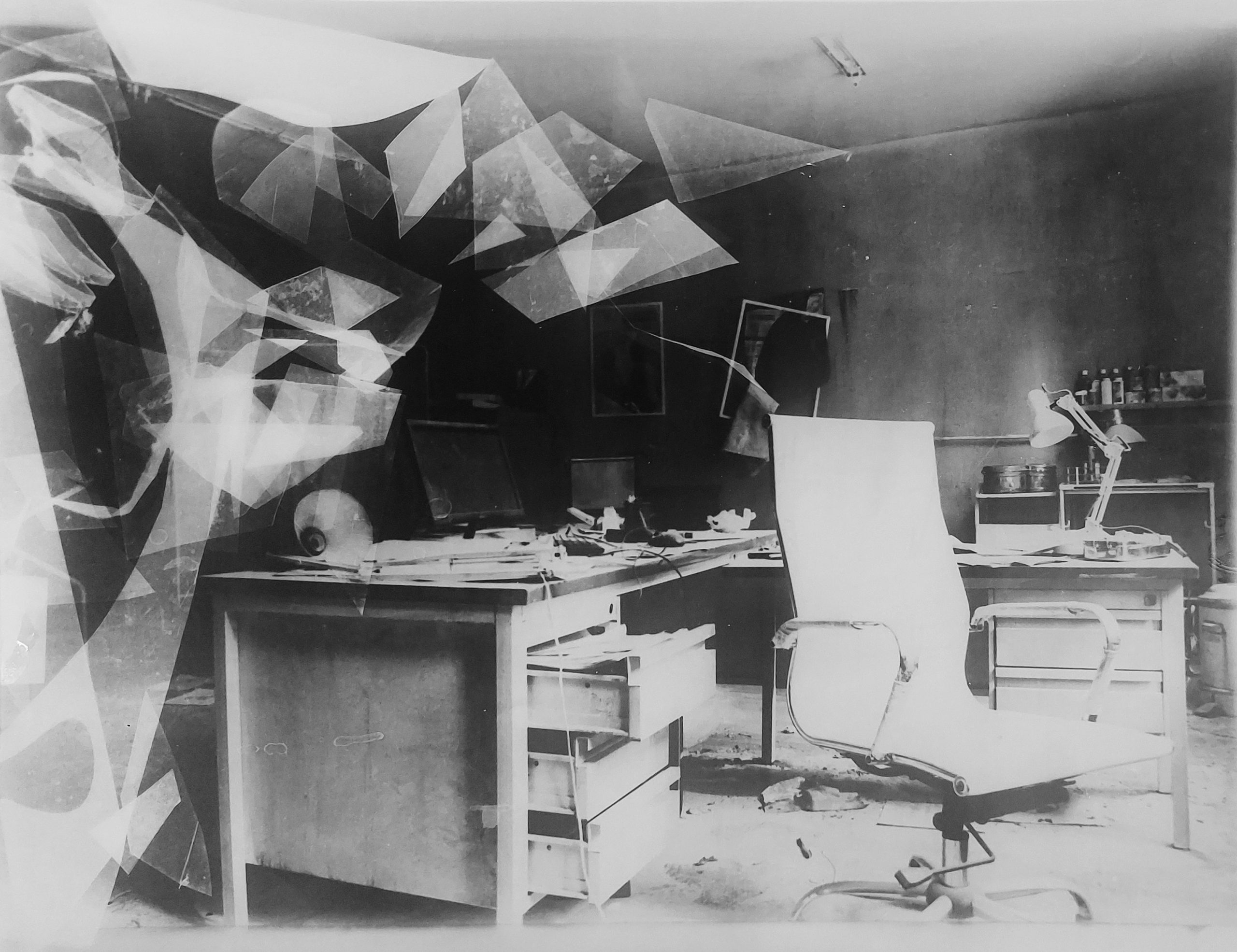
There are images that seem to stem from a distant past while appearing as if they have only just surfaced. Raymond Gantner’s works belong to these headstrong images. They revolve around objects, spaces, landscapes, and the traces left behind by humans.
In his early series on interiors and landscapes, discarded furniture from abandoned rooms and the peripheries of the Munich area become the raw material for an alchemical process in the darkroom. There, these found objects transform into hybrid spaces and futural cityscapes—urban landscapes stripped of any fixed location through experiments with light, chemistry, and filters. Gantner does not simply search for a motif; he creates the conditions under which an image can take shape in the first place. At the center lies the tension between the emergence and the disappearance of structure.
Trained as a painter and sculptor, Gantner connects to the experimental spirit of early photography, a time when the medium was not yet fully controllable and chance acted as a collaborator. Control interests him only to a limited extent: he keeps it porous, allowing for errors and making dust and background noise visible—everything that technical and chemical processes usually seek to hide. Photochemistry no longer serves merely for reproduction but is applied like paint; the boundaries between photography, print, drawing, and sculpture begin to blur.
In “Singularität” (Singularity), his exhibition at Anna25 in Berlin, Gantner pushes this field further. The images no longer seek to illustrate the world; instead, they return to it as disruptions. The works appear compact and vulnerable at once, marked by time, as if they carried afterimages within them that resist reality. The exhibition traverses an illogical timeframe: cutting, assembling, distorting, setting in motion, and freezing again. This results in “image-bodies” that look like fragments of a future archaeology—photographs that show less than they condense the experience of time, friction, and layering. From the friction between photography, painting, and sculpture emerges a visual language that does not aim for the “correct” motif, but for a way of seeing that withstands ambivalence.
Every work is born half from apparatus and half from physical labor: cutting, collaging, exposing, layering, erasing, and re-inscribing. Negatives are segmented, overlaid, and reassembled until a distinct visual consciousness stirs within them. A peculiar energy stretches between the mechanics of the device and the gesture of the hand, between distance and proximity. Nothing rests. The images remain in a state of suspension between becoming and passing away, as if trying to escape a definitive state. Instead of snapshots, “time folds” are created, in which several states remain present simultaneously.
Geometric shapes often appear above these surfaces, almost floating. They explain nothing, comment on nothing; they enter as shifts, as shadows of meaning. Like fragments of a structure that has forgotten its form, they permeate the image field, cutting through soft transitions with hard lines and opening a second level through their opacity. Form and structure trade roles: what promised stability becomes uncertain; supposed errors carry the tension. The image directs the gaze back onto itself.
To observe these forms means to endure delay. Nothing presents itself at first glance. The eye must grow accustomed to the silence between the fragments, to the floating rhythm of the composition. Gantner suggests that an image can only survive today if it evades quick access—if it offers resistance to the smoothly consumable, ever-available images of our present. His photographs refuse immediate legibility and insist that seeing is a matter of time. This is their contemporary core: the image asserts its own duration against the pulse of visual streams.
So, what do we encounter in “Singularity”? Not glossy prints that merge seamlessly into digital feeds, but physical image-objects: photographs and photograms whose materiality remains palpable, their surfaces bearing scratches, dust, and chemical shadows. We hold unique pieces in our hands, results of a process in which the motif is never more important than the interplay of medium, material, and creation. The works do not aim for a singular statement; they remain permeable, testing our willingness to tolerate ambiguity. Their strength lies in this duality: they are simultaneously heavy with meaning and fragile in the moment, as if they could fall apart at any time—and it is precisely this that makes their presence so haunting.
Beyond photography, Gantner also works serially with layering and superimposition—for example, in screen prints, wooden objects, or kinetic sculptures, where the principle of stacking is translated into space. This creates a cohesive body of work in which the media comment on and subvert one another. In “Singularity,” this dialogue culminates in the photographic image: as an image surface, as the trace of a chemical event, and as a carrier of imaginary architectures.
Thus, Gantner’s position can be clearly located in the contemporary. In an age of infinite reproducibility and editability, he insists on the individual image as an event—as a singularity that eludes the flow. His works ask what an image can be today if it wants to be more than illustration or information: a place of resonance, of disruption, of tentative thought. “Singularity” shows Raymond Gantner as an artist who understands photography not as a closed medium, but as an open field where painting, sculpture, and the history of technical images intersect. His works act like small gravitational fields: they draw the gaze in, shift our coordinates, and release us without a final interpretation. Their true significance lies in this unrest—in the state of suspension between image and world.